According to the rule of St. Benedict of Nursia, who laid down this important foundation for monastic life in the Christian West in the 6th century, monks should not be idle. The works of their hands (opera manuum) should provide them with their livelihood: »They are truly monks when they live from the work of their hands, as our fathers and the apostles did.«[1] However, it is always necessary to find the right balance. Although the work should provide for the monastery’s livelihood, the sale of products must not be profit-oriented: »When setting prices, the evil of greed must not creep in. In fact, one should always sell something slightly cheaper than is otherwise possible outside the monastery.«[2]
When we speak of the work of the hands here, we do not primarily mean craftsmanship as opposed to the work of farmers. The Regula Benedicti distinguishes between general manual labour and craftsmen, who are referred to as artifices (artists). They, in turn, should »perform their work in all humility, if the abbot allows it. But if any of them become haughty because they are proud of their professional skills (…), their work shall be taken away from them. They may only resume it when they show humility (…)«[3]
It was primarily agricultural products that were produced by the monastic community. The foundations of the monastic economy were grain cultivation and livestock farming. One example of this is Lehnin Abbey in the Mark of Brandenburg. Here, wheat and rye as well as oats and barley were grown, and there is evidence of poppy cultivation. The monastics[4]. also devoted their efforts to wine and fruit growing. Livestock was kept to provide wool and hides for their own supply, but also to enable transport. Felt shoes were made because the monks needed warm shoes for nightly prayers in the unheated church. It soon became apparent that the products enjoyed a good reputation beyond the monastery, even though they were not produced directly for the market: »Secular and ecclesiastical lords had their coveted footwear – including hunting boots – delivered from their Cistercian monastery. Others claimed the annual levy of cloth, including high-quality Jägertuch cloth.«[5]
The monasteries were primarily meant to produce for their own needs. Because the monks and nuns in their convents were considered instruments of the spiritual art of living abstemiously and not indulging in the pleasures of food, it was inevitable that they would generate surpluses. The French historian Georges Duby (1919–1996) summarised the economic activity of the Cistercians as follows:
»Of all the furs, hides, beams, pig iron bars and shoes, they used only a tiny fraction for themselves. They sold the rest. The Rule of St. Benedict did not prohibit this. The regulations issued by the general chapter of the order allowed the monastic people to go to the markets to buy salt and other essential goods, but above all to exchange their surplus produce for money. The Cistercian abbeys more and more concentrated on trade; from 1140 onwards, they repeatedly called on the lords of the roads, rivers and bridges for exemption from tolls, and established warehouses at the trade centres.«[6]
These warehouses were stores, a so called Klosterhof or Stadthof, in cities with well-established markets where the monasteries could sell their products. Such Klosterhöfe in cities usually consisted of several buildings: in addition to a residential building, there were also storage buildings. However, it was particularly important that these Klosterhöfe differed from other urban tenements in terms of special liberties. They were exempt from municipal taxes and municipal jurisdiction. These places were also exempt from permanent duties such as contributing to the guard on the walls and at the gates of the city. In return, however, a lump sum contribution often had to be paid to the city. For the Cistercian monasteries, Stadthöfe were often essential for their survival: »Unlike the Stadthöfe of some other ecclesiastical institutions, they did not serve solely or primarily as lodgings (for bishops or abbots), but, especially in economic terms, were almost indispensable. Given the large number of Cistercian monasteries founded in the 12th and 13th centuries, by the beginning of the 14th century the Cistercian monastery Klosterhof was a common feature of large to medium-sized German cities.«[7]
Further economic life could flourish around the Klosterhöfe. They were granted liquor licences: wine and beer were available here. Since the monasteries needed animals for transport and for their hides and skins – however, hardly any meat was consumed due to the precepts of abstinence – meat products also often appeared on the market. In some towns, the Cistercians maintained their own meat stalls (e.g. in Hanover and Munich) in order to be able to offer meat on the market[8]. Various special goods, such as glassware, could also be found on the markets.[9].
At this point, it is instructive to mention a field of markets and goods that were not traded in the marketplaces of cities, but which were nevertheless to become trendsetters in an innovative area of the world of goods. Especially research into art and architectural history has made significant contributions to their investigation. It became apparent that sales opportunities for special services were established in the vicinity of monasteries for which otherwise there were no specialists. One indication of this is the work of certain church masons’ guilds: special decorative forms on urban churches may indicate that master-builders were at work here who in monastery buildings had already introduced the most modern techniques of the time to the respective region. One example of this is the town church of St. Nicolai in Treuenbrietzen, Brandenburg. It features »imported architectural elements, including the crossing tower, which is unique in the Mark.«[10]
As in the field of architecture, other artistic products emerged, such as book illumination, which became the distinctive feature of certain monasteries[11]. Admittedly, trademarks by which certain companies can be recognised are a development of modern industrial culture. Trademark law in the modern sense was certainly foreign to the people of the Middle Ages. Nevertheless, certain features already shine through in buildings and illuminated manuscripts, with which individual monasteries brought out their own traits, which could certainly have the effect of a modern brand.
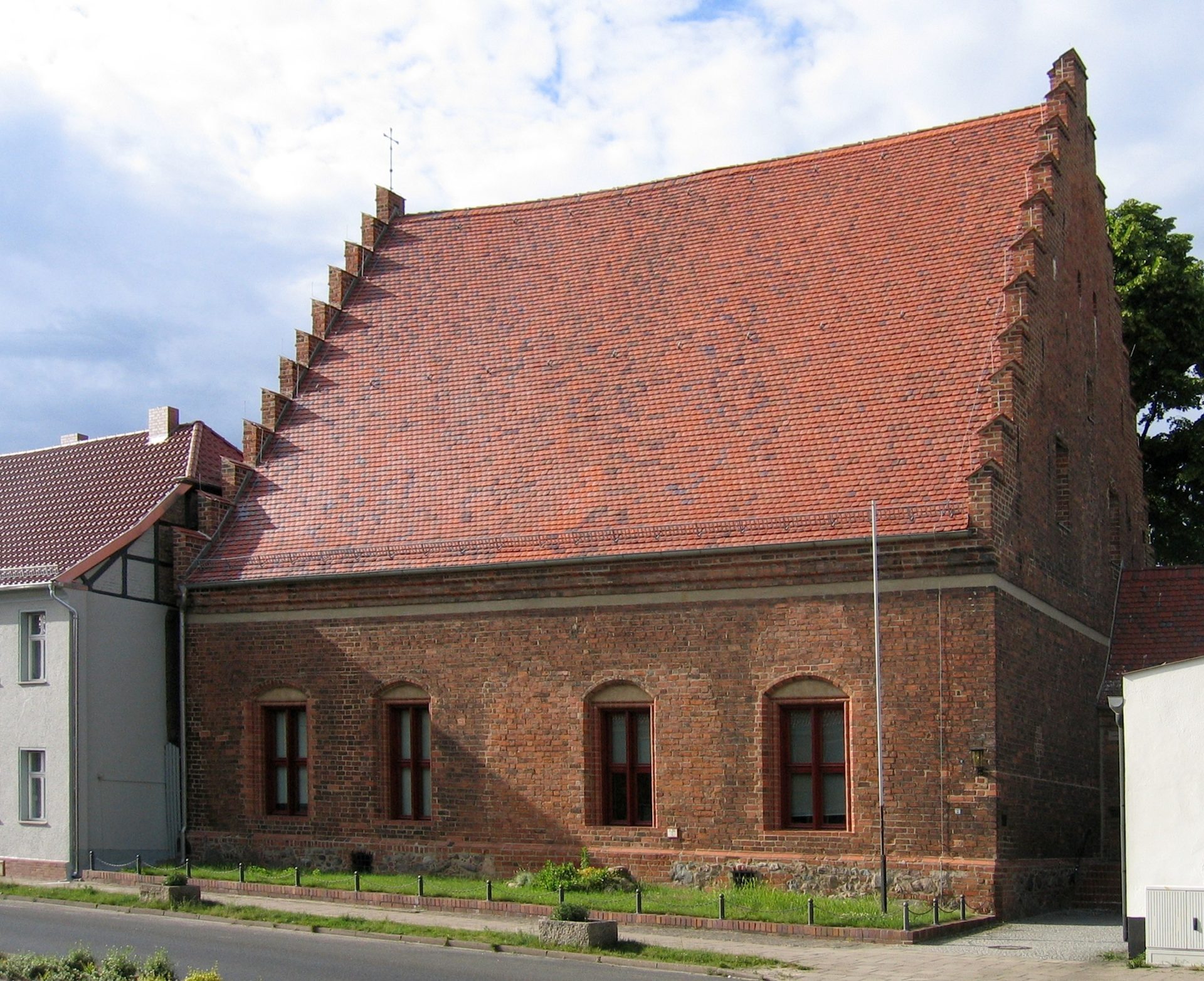
Klosterhof Zinna
However, the monastics’ preoccupation with their own innovative products also went through bad times. While in the High Middle Ages, a period when many new monasteries and towns were founded, the market-based orientation of many monasteries strongly surged, this demand later waned. The fact that the once central economic function of the Stadthöfe faded into the background could also be interpreted by the fact that, for example, the former Stadthof of Zinna Abbey in the town of Jüterbog was only regarded as guest quarters for the abbot since the end of the Middle Ages and thus was called the Abtshof, but was no longer seen as a kind of market hall: »In the late Middle Ages, the economic importance of these independently run establishments continued to decline; the spread of the term Abtshaus (abbot’s house) for urban branches perhaps reflects this trend.«[12]
Today, products from monasteries, monastery markets and even trademarks of monastic origin are playing a role again. For some monasteries, they are a contribution to their economic security and, at the same time, provide a meaningful way of life, for example, according the Rule of St. Benedict. In France, monasteries have created a trademark to document the authenticity of their products. The Belgian Trappists with their breweries are doing the same to distinguish themselves from the many now secular abbey beers. For customers, the idea of supporting a monastery may be just as important as their confidence in a special quality and the magic of the genius loci: taking a piece of the monastery home with them as a souvenir. Apart from these more idealistic aspects, many monastery businesses today are in strong competition with their secular counterparts.